

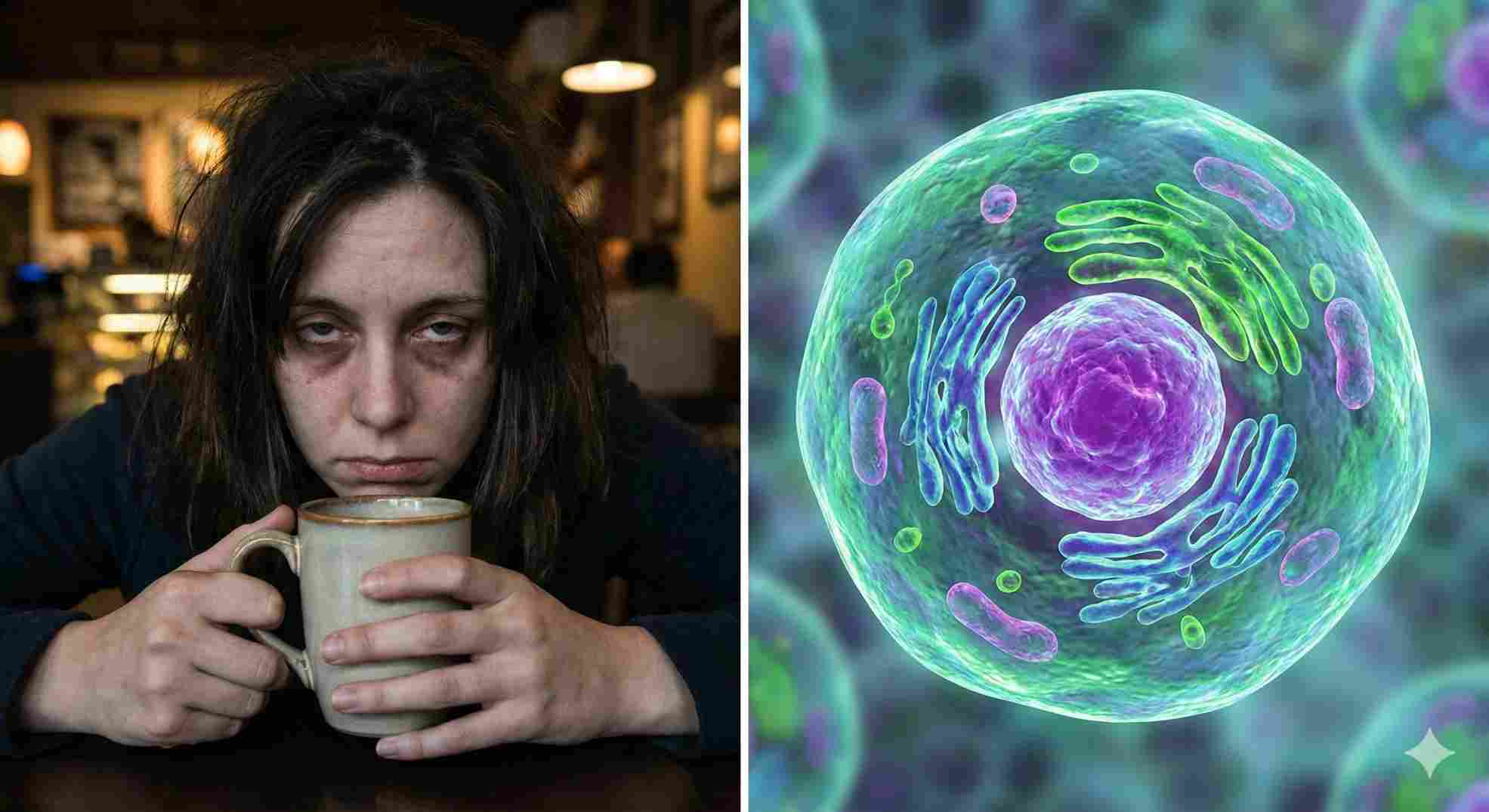
You are eating plenty of food. So why are you starving? Unless you are following a specific mitochondria diet, your cells may be malnourished even if your stomach is full.
It doesn’t make sense on paper. You consume 2,500 calories a day. You sleep seven hours. Yet, you drag yourself out of bed in the morning and hit a wall by 2 PM. You feel older than you are.
The problem isn’t your willpower, and it isn’t “just aging.” The problem is a biological mismatch. We treat the human body like a furnace—throw in fuel (calories), get out heat (energy). But your body isn’t a simple furnace. It is a complex grid of trillions of tiny power plants called mitochondria.
Right now, for most people, those power plants are broken.
When your mitochondria malfunction, it doesn’t matter how clean you eat. If the engine can’t process the fuel, the tank just overflows. In your body, that overflow looks like stubborn fat, brain fog, and a bone-deep weariness that coffee can’t touch.
This guide is about fixing that engine. Central to the Mitolyn Solutions philosophy, the mitochondria diet is a specific way of eating that signals your body to repair its power grid and switch from “storage mode” to “burn mode.”
The Core Problem: The Energy Leak
Most nutrition advice ignores a basic fact: You want your cells to be wasteful.
In engineering, efficiency is good. In metabolism, efficiency means you extract every calorie and store it. That was great for surviving a famine in 10,000 BC. It is terrible for sitting at a desk in 2026.
We want to trigger something called mitochondrial uncoupling. Think of it like revving your car engine while in neutral. You burn through gas (calories) without moving (storing fat). This creates heat. It’s why babies don’t shiver; they have fat rich in mitochondria that burns energy just to keep them warm.
By eating specific mitochondrial uncoupling foods, you flip this switch. You turn your metabolism from a stingy storage unit into a heat-generating machine. Research suggests this process is vital for regulating metabolic health and preventing obesity.
1. Stop the Assault: Foods Bad for Mitochondria
You cannot fix your cells if you keep poisoning them. Before we talk about what to eat, we have to cut out the things that are rusting your biological machinery.
The membrane of a mitochondrion is made of fat. If you eat unstable fats, you build a weak, “leaky” membrane. It’s like trying to inflate a tire made of Swiss cheese.
The “Do Not Eat” List
Industrial Seed Oils: Canola, soybean, corn, and sunflower oils. These are unstable. When your body uses them to build cells, those cells oxidize and break down.
Refined Sugar: This causes a massive energy spike that overwhelms your mitochondria. It creates “exhaust” (free radicals) that damages your DNA.
Processed Flour: Stripped of nutrients, white flour acts exactly like sugar in your blood.
| Food Category | Effect on Mitochondria | The Consequence |
|---|---|---|
| Vegetable Oils | Membrane Oxidation | Cell walls become rigid; nutrients can’t get in. |
| Excess Sugar | Glycation | “Gums up” cellular machinery, stalling energy. |
| Artificial Sweeteners | Gut Disruption | Kills the gut microbiome needed to support cell health. |
| Gluten (Sensitive Groups) | Zonulin Release | Allows toxins to leak into the blood, stressing cells. |
2. The Rebuild: Mitochondria Boosting Foods
To build a mito food plan that works, you need three things: solid fats for the membrane, signals to repair the cell, and the right nutrients to spark the energy.
The Fats (Membrane Builders)
You need stable fats to build a stable cell.
Omega-3s: Wild-caught salmon, sardines, mackerel. These are the building blocks known to support cellular integrity.
MCT Oil (C8): This is unique. It skips the normal digestion process and goes straight to the liver to be turned into ketones—a “superfuel” that burns incredibly clean.
The Signals (Phytonutrients)
Plants provide stress signals. When you eat a plant that had to struggle to survive (like a wild blueberry fighting off a fungus), your body gets a signal to toughen up its own defenses. This is called xenohormesis.
PQQ: Found in parsley and kiwi. It actually stimulates the growth of new mitochondria.
Sulforaphane: Found in broccoli sprouts. It turns on your body’s internal antioxidant system.
Resveratrol: Found in red grape skins. It mimics the cellular effects of fasting.

The “Uncouplers” (Metabolism Hacks)
These mitochondrial uncoupling foods help you waste energy as heat (which is a good thing).
Chili Peppers: Capsaicin raises your body temp.
Turmeric: Protects the cell while burning energy.
Green Tea: Contains EGCG, a compound that protects brain mitochondria.
3. The Protocol: A 7-Day Strategy
This isn’t just a list of foods. It’s a schedule. The mitochondria diet plan relies on when you eat just as much as what you eat.
The Rules:
1. Tighten the Window: Eat all your meals within 8 to 10 hours. Give your body the other 14 hours to clean up cellular waste, a process known as autophagy.
2. Earn Your Carbs: Eat fats and proteins during the day to keep energy steady. Save carbohydrates for dinner or immediately after a workout.
3. Rotate: Don’t eat the same vegetable every day.
| Meal | The Old Way (Avoid) | The Mito Way (Eat) | Why It Works |
|---|---|---|---|
| Breakfast | Cereal, toast, juice | Black coffee + MCT Oil OR Eggs with spinach | Keeps insulin low; forces fat burning. |
| Lunch | Sandwich and chips | Sardine salad with olive oil and walnuts | Provides Omega-3s for cell membranes. |
| Snack | Granola bar | Macadamia nuts or dark chocolate (85%) | Dark chocolate is a potent mito booster. |
| Dinner | Pasta | Grass-fed beef with roasted Brussels sprouts | Sulfur in sprouts aids detox; protein rebuilds. |
4. Why This Isn’t Just “Keto”
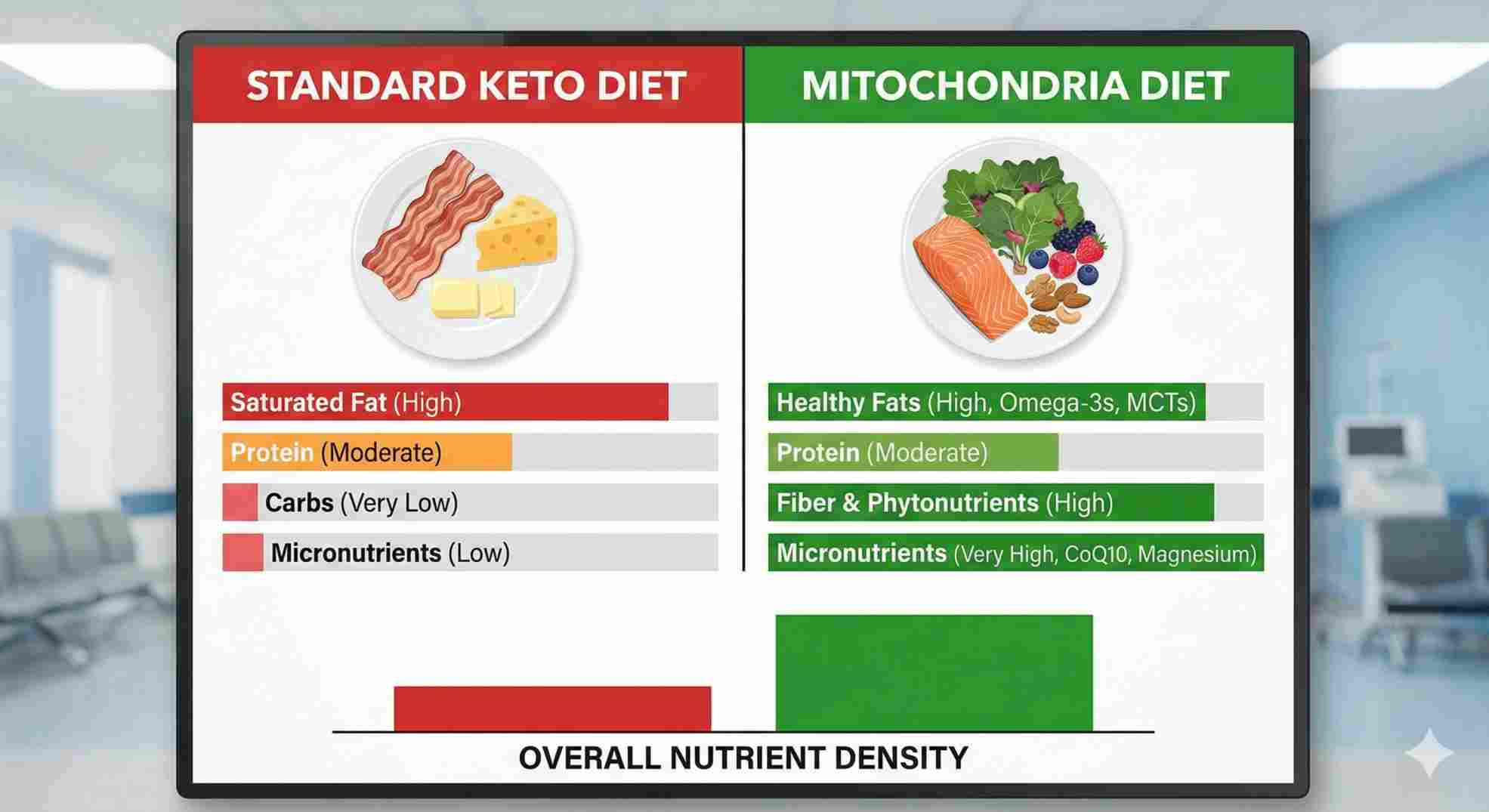
You might look at this and think, “This is just Keto.” It’s similar, but the goal is different.
Standard Keto focuses on macros (Fat vs. Carbs). The mitochondria health diet focuses on micros. You can be in ketosis eating hot dogs and cream cheese, but your cells will still be starving for magnesium and B-vitamins.
You need these specifics:
Magnesium: Without it, you cannot make ATP (energy). Eat pumpkin seeds and spinach.
B-Vitamins: Specifically Riboflavin (B2) and Niacin (B3). These carry the electrons in your cells. Find them in organ meats and nutritional yeast.
CoQ10: The spark plug. Found in heart, liver, and muscle meat.
The Bottom Line
You aren’t destined to be tired just because you’re getting older. Fatigue is a check-engine light. It’s telling you the fuel mixture is wrong.
By switching to a mitochondria diet, clearing out the inflammatory oils, and loading up on mito booster foods, you are doing more than losing weight. You are changing how your body generates energy at the deepest level.
Start simple. Swap your breakfast oil. Add some sprouts to dinner. Your cells are waiting for the fuel they actually need.
Ready to see real changes in the mirror? Try Mitolyn risk-free for 90 days and lock in today’s special discount before it expires
Frequently Asked Questions:
How long until I feel it?
You’ll likely feel better within 3 days just from stabilizing your blood sugar. But actually growing new mitochondria (biogenesis) takes about 4 to 8 weeks of sticking to the mito diet.
Can I do this as a vegan?
Yes, but it’s harder. You won’t get Carnitine or CoQ10 from meat, so you have to supplement them. Lean heavily on algae, nuts, seeds, and foods that help mitochondria like dark leafy greens.
Is coffee okay?
Actually, yes. Coffee has chlorogenic acid which helps recycle old cells. Just make sure it’s organic—pesticides are foods bad for mitochondria.
Do I need supplements?
Food comes first. But our soil isn’t what it used to be. If you are over 40 or chronically tired, a stack of Magnesium, CoQ10, and PQQ can help bridge the gap.