
You have probably heard a thousand times that the mitochondria are the “powerhouse” of the cell. It’s the one fact from biology class that sticks with everyone. But let’s be honest: memorizing a catchy nickname doesn’t tell you how your body actually works. To really understand your health, energy, and even how you age, you need to understand one fundamental biological rule: cellular respiration takes place in the mitochondria.
It sounds technical, but it’s actually pretty simple when you strip away the jargon. Your body needs fuel. You eat food, but your cells can’t run on a sandwich. They need a specific chemical battery called ATP (Adenosine Triphosphate). The process of turning that sandwich into ATP is messy and dangerous. It requires oxygen and creates toxic byproducts. That is why cellular respiration takes place in the mitochondria—it is the only safe place for this volatile chemistry to happen.
We often hear about mitochondrial metabolism and energy, but we rarely look at the machinery running the show. If this process stops, you don’t just get tired. You die within minutes. That is how critical this tiny organelle is. In this guide, we are going to walk through the “how” and “why” without the textbook boredom. We’ll look at the machinery, the fuel, and the specific reasons cellular respiration takes place in the mitochondria and nowhere else.
The Real Reason Location Matters
Here is the thing most people miss. The cell is like a busy factory floor. The cytoplasm (the fluid filling the cell) is full of workers building proteins, moving trash, and sending signals. You can’t have a massive, fiery furnace in the middle of a crowded room.
Cellular respiration takes place in the mitochondria because it effectively contains a “fire.” This process uses oxygen to strip electrons from food—a reaction that releases a lot of heat and energy. If this happened loose in the cell, it would cook the other organelles. The mitochondria have double walls (membranes) to keep this heat and energy contained. It’s all about safety and efficiency.
The Hardware: What Are Mitochondria?
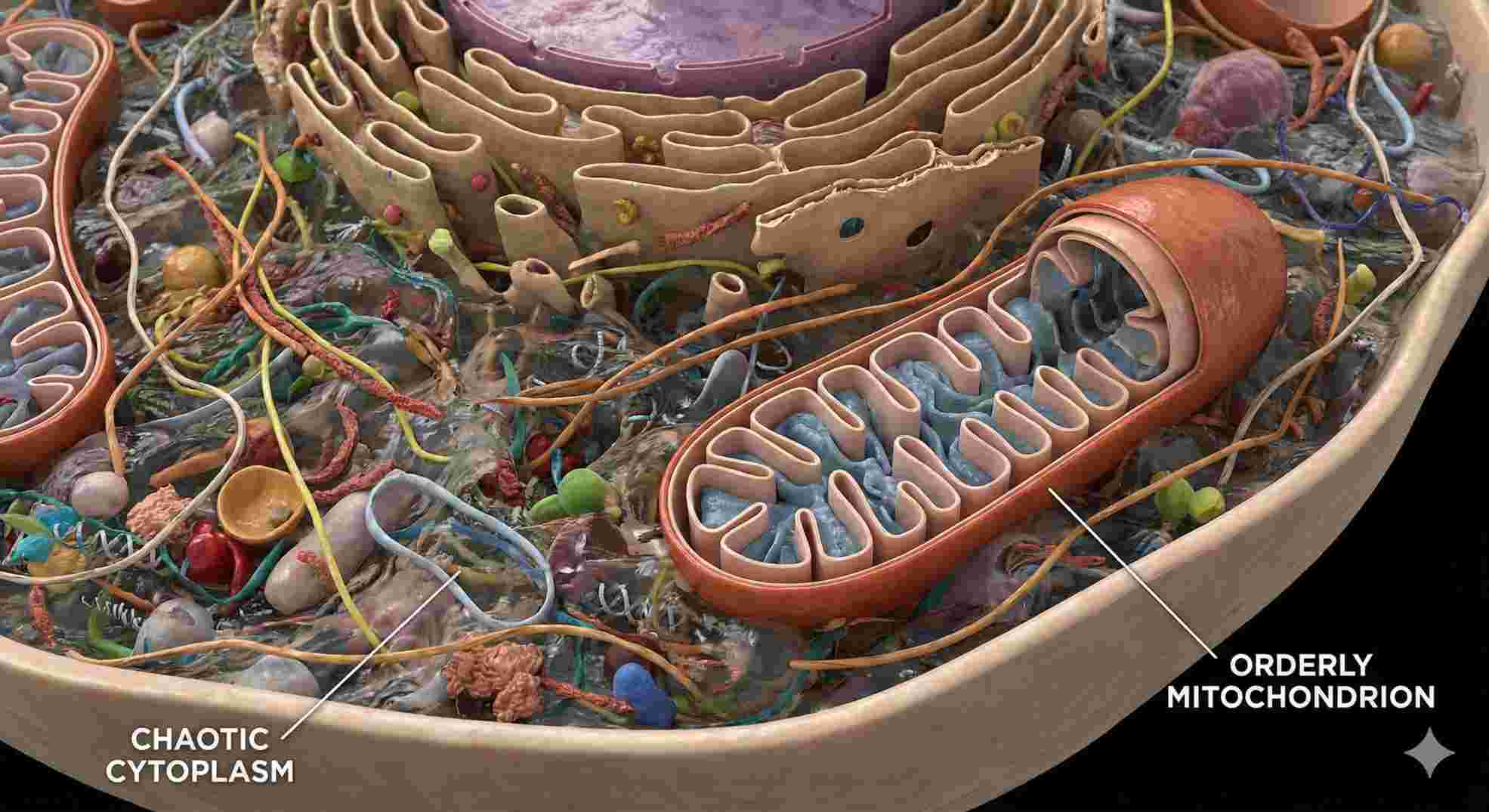
Before we look at the process, look at the machine. Mitochondria are weird. They look like little beans floating in your cells, but they act like independent bacteria. They even have their own mitochondrial DNA. This unique structure is exactly why cellular respiration takes place in the mitochondria.
It has two layers. The outer skin is smooth, but the inner skin is folded back and forth like a darker accordion. These folds are called cristae. Why the folds? Imagine trying to fit a massive solar panel into a small backpack. You’d have to fold it. The folds give the mitochondrion a huge surface area to pack in the “turbines” that generate power.
Inside those folds is the matrix. This is a thick soup of enzymes. The matrix in cellular respiration is where the chemical prep work happens. Without these two distinct zones—the matrix and the folded membrane—the process would fail.
The Partnership
There is a strict division of labor here. Your cell does the prep work; the mitochondrion does the heavy lifting. Mitochondria and cellular respiration are a package deal.
The cell takes glucose and cracks it in half. This is called glycolysis, and it happens outside the mitochondria. But that only yields a tiny bit of energy. To get the real payoff, the remains of that glucose (called pyruvate) are shipped inside. Glucose is broken down by the mitochondria by what process? Technically, the mitochondria don’t touch the glucose. They take the pyruvate, process it, and squeeze every last drop of energy out of it.
This hand-off is seamless. As soon as the fuel enters, we can officially say cellular respiration takes place in the mitochondria.
The Process: Step-by-Step
Let’s trace the journey of a single breath of air and a bite of food. It’s a three-act play, and the drama ramps up with every step.
1. The Entry (The Link Reaction)
The fuel arrives at the door. Pyruvate from the cytoplasm crosses the double membrane. As soon as it hits the matrix, an enzyme grabs it and rips off a carbon atom.
This carbon atom grabs some oxygen and becomes CO2. This is the exact moment carbon dioxide is made. You breathe it out later. The remaining fuel is turned into Acetyl-CoA. This molecule is the “VIP ticket” for the next stage. It proves that cellular respiration takes place in the mitochondria, as this specific enzyme doesn’t exist anywhere else in the cell.
2. The Grinder (The Krebs Cycle)
Now the fuel enters the matrix in cellular respiration. The Krebs Cycle (or Citric Acid Cycle) is like a recycling center. It takes the Acetyl-CoA and spins it through a series of changes.
It doesn’t make much fuel directly. Instead, it strips electrons. Think of electrons as cash. The Krebs cycle strips the cash off the carbon and hands it to “bagmen” molecules called NADH and FADH2. These carriers rush off to the inner membrane.
3. The Payoff (The Electron Transport Chain)
This is the main event. This is why are mitochondria important to aerobic cellular respiration.
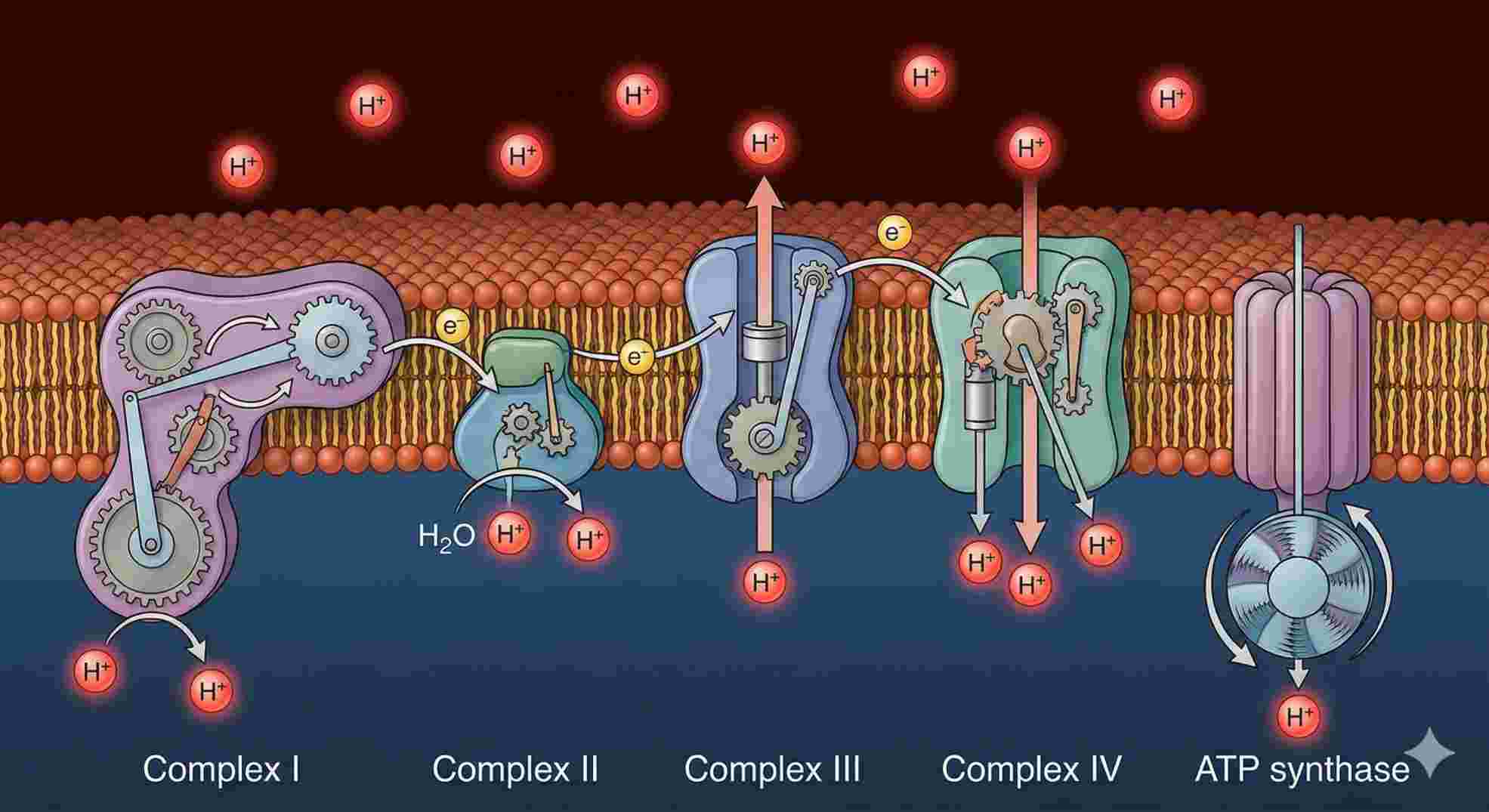
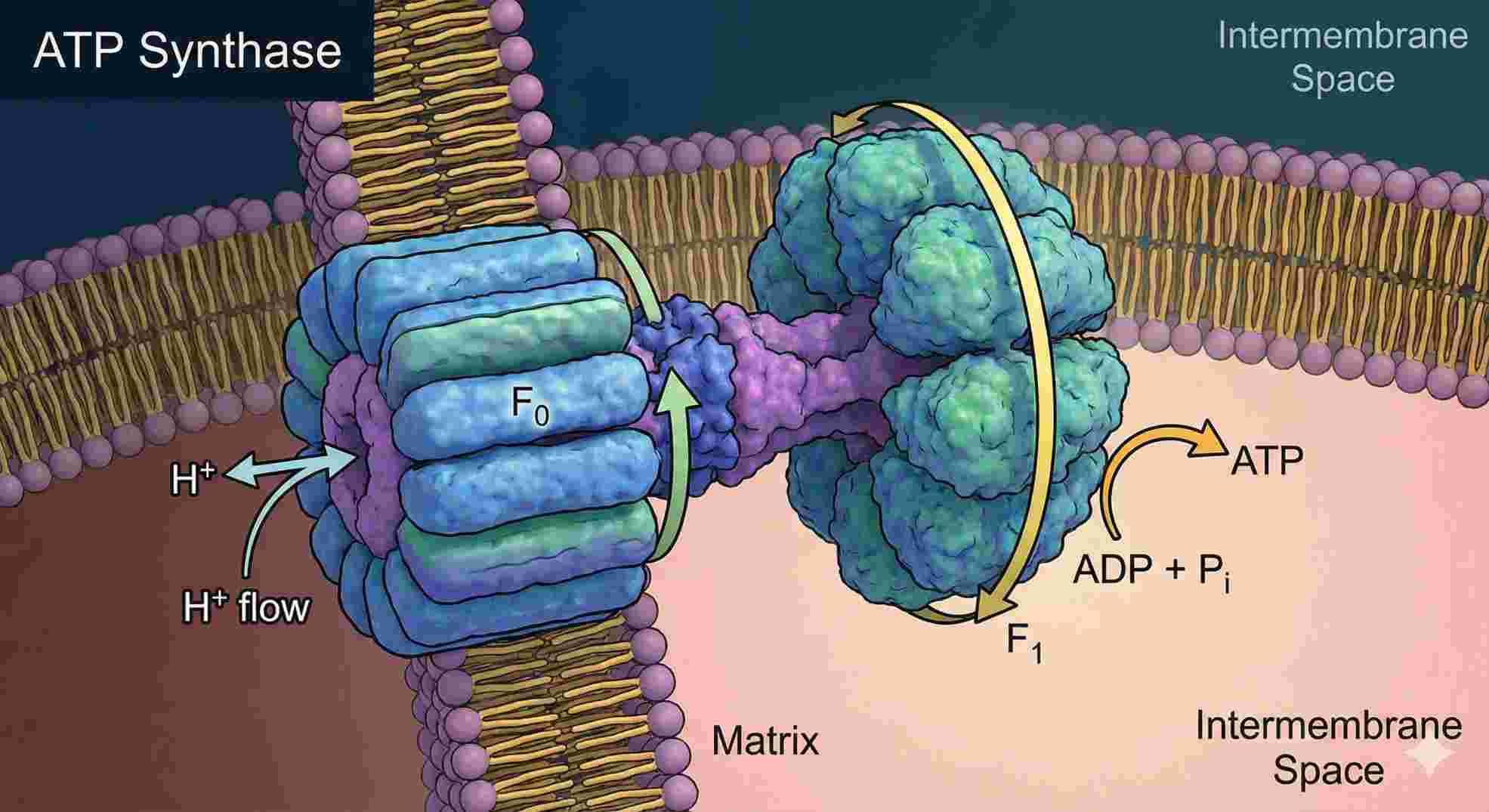
The electron carriers arrive at the inner membrane. They dump their electrons into a chain of pumps. As the electrons flow down the chain, they power these pumps. The pumps push protons (hydrogen ions) out of the matrix.
This creates a proton gradient in cellular respiration. It’s like pumping water up into a dam. The pressure is immense. The protons want to get back in, but they can’t pass the membrane. They have to go through a special turbine called ATP Synthase. As they rush through, the turbine spins. This spinning smashes molecules together to create ATP.
Oxygen waits at the end of the line to catch the used electrons. This is why you breathe. Without oxygen, the line stops, the pumps fail, and you die. This absolute need for oxygen confirms that aerobic cellular respiration takes place in the mitochondria.
The Scoreboard: Where the Energy Comes From
Let’s look at the numbers. Why does the cell bother with all this complexity? Because the payout is huge.
| Stage | Where does it happen? | What goes in? | What comes out? | Energy Yield |
|---|---|---|---|---|
| Glycolysis | Cytoplasm (Outside) | Glucose | Pyruvate | 2 ATP (Tiny) |
| Krebs Cycle | Mitochondrial Matrix | Acetyl-CoA | Electrons (NADH) | 2 ATP (Tiny) |
| Electron Transport | Inner Membrane | Electrons + Oxygen | Water | 32-34 ATP (Huge) |
The difference is laughable. If you relied only on the cytoplasm, you’d need to eat 15 times more food to stay alive. The fact that cellular respiration takes place in the mitochondria makes efficient life possible.
What Role Do Mitochondria Play in Cellular Respiration?
If you want the simple answer to what role do mitochondria play in cellular respiration, it is this: they are the closers.
The cell starts the job, but the mitochondria finish it. They handle the dangerous part. Using oxygen to burn fuel is risky. It creates free radicals—loose cannons that can damage DNA. The mitochondria are built to contain this risk. They have their own antioxidant squads (like Superoxide Dismutase) to mop up the mess.
So, what is the role of mitochondria in cellular respiration beyond making energy? Protection. They keep the rest of the cell safe from the “nuclear reactor” inside.
The Oxygen Connection
This is where the “aerobic” part comes in. Aerobic means “with air.” Respiration in the mitochondria is strictly aerobic.
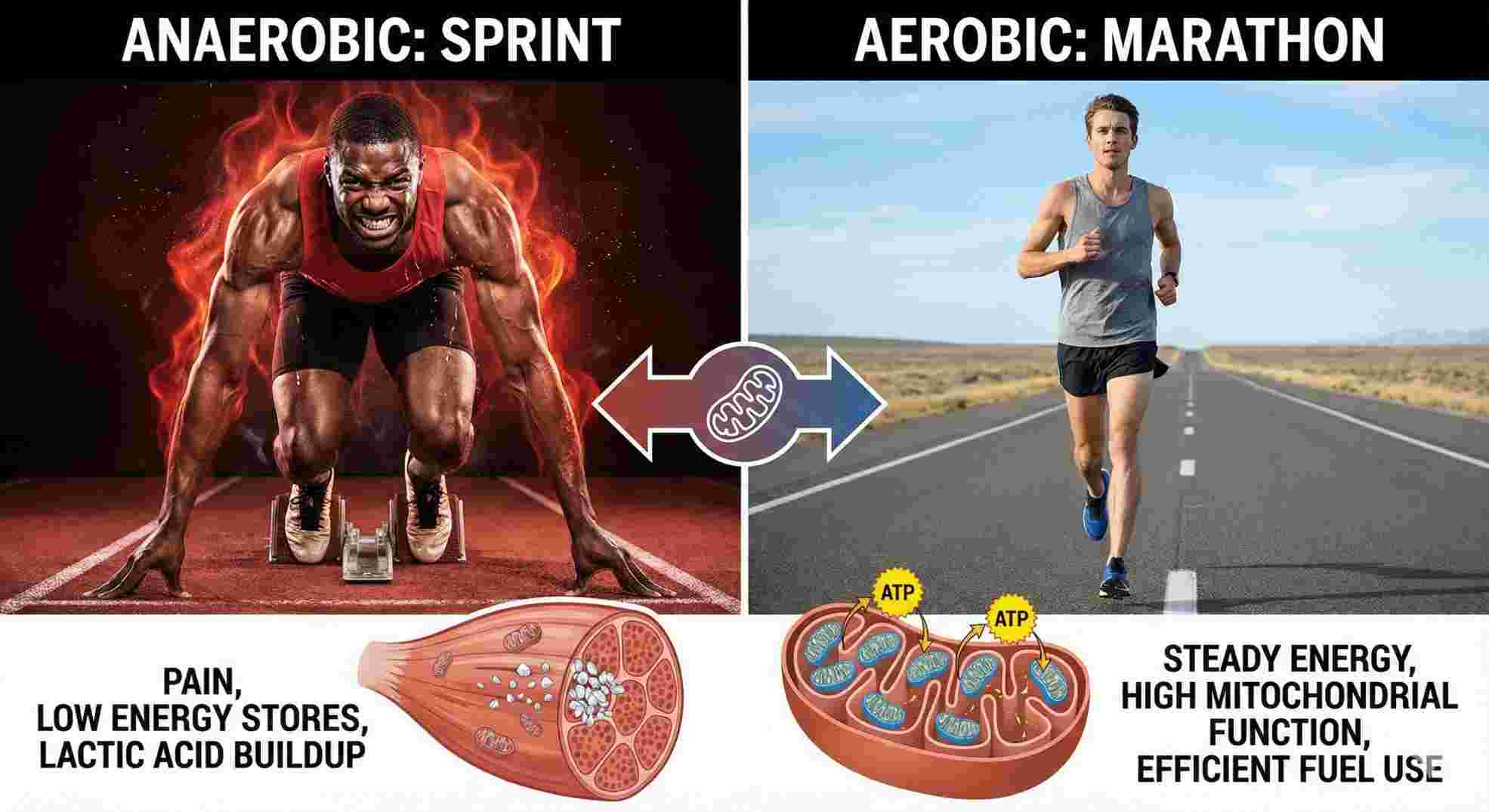
If you are sprinting for a bus, your muscles might run out of oxygen. When that happens, the mitochondria shut down. Your cells switch to a backup plan in the cytoplasm called fermentation (creating lactic acid). It burns, it hurts, and it doesn’t last long. As soon as you stop and gasp for air, oxygen rushes back in, and cellular respiration takes place in the mitochondria again, clearing the debt.
Do Mitochondria Produce Glucose?
Let’s clear up a massive misconception. I hear this all the time. Do mitochondria produce glucose?
No. Absolutely not.
Think of a car. Does the engine produce gasoline? No, it burns gasoline. Mitochondria are the engine. They burn fuel. Plants have a different organelle called a chloroplast. That is the fuel factory. Chloroplasts make the sugar; mitochondria burn the sugar.
| Feature | Mitochondria (The Engine) | Chloroplasts (The Factory) |
|---|---|---|
| Job | Burn Fuel | Make Fuel |
| Process | Cellular Respiration | Photosynthesis |
| Found In | Animals, Plants, Fungi | Plants & Algae Only |
| Key Logic | Cellular respiration takes place in the mitochondria | Photosynthesis takes place here |
Plants are smart—they have both. We only have the engine. We have to eat our fuel.
The Math: The Equation for Mitochondria
Biology is just chemistry in action. We can write the whole process down as a formula.
The Full Equation:C6H12O6 (Glucose) + 6O2 (Oxygen) → 6CO2 (Carbon Dioxide) + 6H2O (Water) + ATP (Energy)
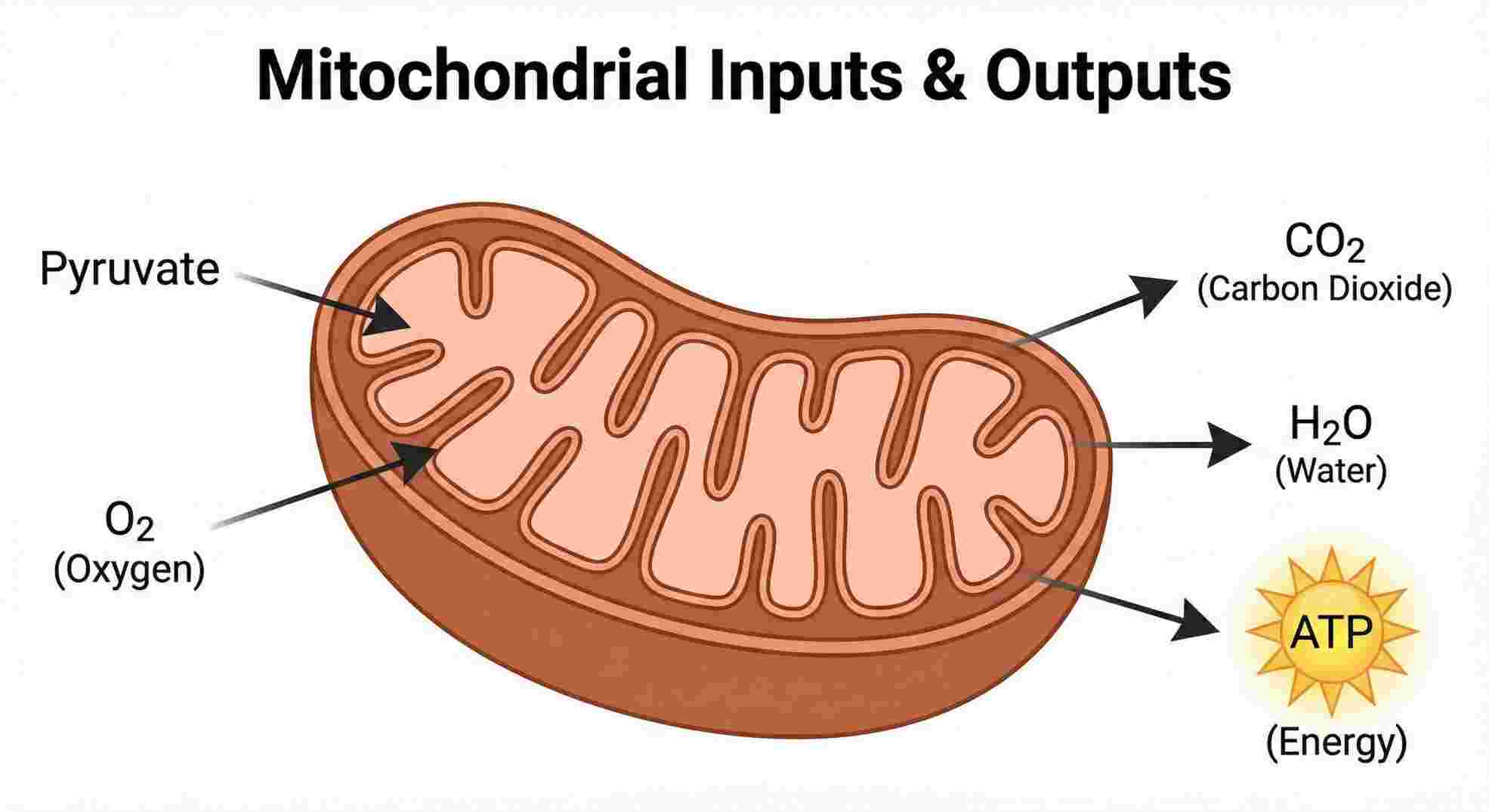
But if we look at the equation for mitochondria specifically, we look at the inputs and outputs of the organelle itself.
- Input: Pyruvate + Oxygen
- Action: The Krebs Cycle spins, The Electron Chain pumps.
- Output: Carbon Dioxide + Water + ATP
This is why you exhale CO2. It is literally the exhaust fumes from the Krebs cycle. It is proof that cellular respiration takes place in the mitochondria inside your chest right now.
Why Are Mitochondria Important to Aerobic Cellular Respiration?
We know the “how,” but let’s hammer home the “why.” Why are mitochondria important to aerobic cellular respiration? Why couldn’t the cell just do this in the fluid?
- Concentration: The enzymes needed for this are expensive for the body to make. If they were floating in the massive cytoplasm, they would be too spread out. The matrix keeps them packed tight so reactions happen fast. Cellular respiration takes place in the mitochondria for speed.
- The Dam Effect: Remember the proton gradient? You need a barrier to build pressure. If you tried to build water pressure in an open lake, it wouldn’t work. You need a dam. The inner membrane is that dam. It is impermeable.
- Control: This process is adjustable. If you start running, your mitochondria ramp up. If you sleep, they slow down. Having a dedicated organelle allows for this fine-tuning.
| Comparison | Aerobic (With Air) | Anaerobic (No Air) |
|---|---|---|
| Location | Cellular respiration takes place in the mitochondria | Cytoplasm |
| Sustainability | Indefinite (Marathon) | Seconds/Minutes (Sprint) |
| Waste Product | Water (Harmless) | Lactic Acid (Toxic) |
The Bottom Line
Your body is smarter than any computer. It knows that to generate massive energy, you need a dedicated, safe environment. You can’t just burn fuel anywhere.
That is why cellular respiration takes place in the mitochondria. It is a design choice that allows us to be complex, active, thinking beings. Every movement you make, every thought you have, and every beat of your heart is powered by these tiny engines humming away inside you. So, the next time you take a deep breath, remember where that oxygen is going. It’s heading straight for the matrix to keep the lights on.

Ready to see real changes in the mirror? Try Mitolyn risk-free for 90 days and lock in today’s special discount before it expires
Frequently Asked Questions:
Does all cellular respiration occur in the mitochondria?
Not 100%. The warm-up act (glycolysis) happens outside. But the main event—the part that actually keeps you alive—is aerobic, and that cellular respiration takes place in the mitochondria.
What is the role of the matrix in cellular respiration?
Think of the matrix as the mixing bowl. The matrix in cellular respiration holds the enzymes that strip electrons from your food. Without the matrix, the Krebs cycle stops.
Glucose is broken down by the mitochondria by what process?
Trick question! Mitochondria don’t break down glucose. They break down pyruvate. The process is called the Krebs Cycle (or Citric Acid Cycle), followed by the Electron Transport Chain.
How is the proton gradient in cellular respiration created?
It is created by the electron transport chain. Proteins pump protons across the inner membrane, trapping them between the walls. This built-up pressure is the proton gradient in cellular respiration.
What is the specific equation for mitochondria?
While the cell uses glucose, the mitochondrion uses pyruvate. The specific equation is roughly: Pyruvate + Oxygen -> Carbon Dioxide + Water + ATP.